


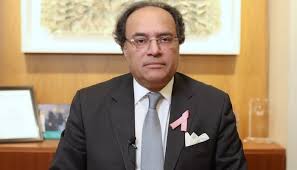
Federal Finance Minister Muhammad Aurangzeb emphasized on Thursday that the government is committed to advancing structural reforms in critical sectors, stating that further delays are not an option.
Speaking at the groundbreaking ceremony for the Head Office Building of the Securities and Exchange Commission of Pakistan (SECP), the finance minister reiterated the government’s intention to proceed with reforms in taxation, energy, state-owned entities (SOEs), and privatization, all under the guidance of the International Monetary Fund (IMF).
“We must move forward because there is no longer any room to defer this agenda,” Aurangzeb asserted.
Last month, Islamabad authorities reached a staff-level agreement with the IMF for a $7-billion, 37-month loan program aimed at ensuring stability and fostering inclusive growth.
Commenting on the current economic situation, Aurangzeb highlighted recent developments, including the Fitch upgrade and the State Bank of Pakistan’s (SBP) decision to lower the policy rate, as clear indicators of the macroeconomic stability being pursued. He assured that the economic team would continue to push forward with this agenda.
On Monday, the Monetary Policy Committee (MPC) of the SBP reduced the key policy rate by 100 basis points to 19.5%, marking its second consecutive rate cut. Additionally, Fitch Ratings upgraded Pakistan’s Long-Term Foreign-Currency Issuer Default Rating (IDR) to ‘CCC+’ from ‘CCC’.
Aurangzeb also underscored the importance of achieving macroeconomic stability to drive growth, stressing that stabilization is a precursor to sustainable growth.
Regarding the privatization of SOEs, Aurangzeb indicated that the government plans to transition all public sector insurance companies into private hands. He argued that there is no justification for the government to retain control over these entities or functions, even those considered strategic.
Looking ahead, Aurangzeb emphasized the need for export-led growth and foreign direct investment (FDI), noting that external borrowing should be focused on projects that generate foreign currency for the country.
He also pointed out the necessity for equity and debt markets to play a larger role, enabling the government to diversify its funding sources.
The finance minister has faced significant criticism from salaried citizens due to high taxation, while various industries, including cement, flour millers, and petroleum dealers, have also expressed dissatisfaction with several budget measures.
Despite securing another IMF bailout, the government remains under pressure due to high energy tariffs and the lack of economic growth.
4o